AI for Business

Explore the best AI for Business — independent reviews, comparisons, pricing and step-by-step how-to guides, curated by Aizhi.

  • Software engineering demographics

    Software engineering demographics

    Software engineers make up a significant portion of the global workforce. As of 2022, there are an estimated 26.9 million professional software engineers worldwide, up from 21 million in 2016. == By country == === United States === In 2023, there were an estimated 1.6 million professional software developers in North America. There are 166 million people employed in the US workforce, making software developers 0.96% of the total workforce. ==== Summary ==== ==== Software engineers vs. traditional engineers ==== The following two tables compare the number of software engineers (611,900 in 2002) versus the number of traditional engineers (1,157,020 in 2002). There are another 1,500,000 people in system analysis, system administration, and computer support, many of whom might be called software engineers. Many systems analysts manage software development teams, and as analysis is an important software engineering role, many of them may be considered software engineers in the near future. This means that the number of software engineers may actually be much higher. It is important to note that the number of software engineers declined by 5 to 10 percent from 2000 to 2002. ==== Computer managers vs. construction and engineering managers ==== Computer and information system managers (264,790) manage software projects, as well as computer operations. Similarly, Construction and engineering managers (413,750) oversee engineering projects, manufacturing plants, and construction sites. Computer management is 64% the size of construction and engineering management. ==== Software engineering educators vs. engineering educators ==== Most people working in the field of computer science, whether making software systems (software engineering) or studying the theoretical and mathematical facts of software systems (computer science), acquire degrees in computer science. According to the U.S. Bureau of Labor Statistics (May 2023 data), there were approximately 44,800 postsecondary computer science teachers and 50,300 engineering teachers, indicating that the computer science educator workforce is nearly 89% as large as that of engineering educators. The combined number of postsecondary chemistry (25,400) and physics (17,100) teachers totaled 42,500, slightly less than the number of computer science educators. ==== Other software and engineering roles ==== ==== Relation to IT demographics ==== Software engineers are part of the much larger software, hardware, application, and operations community. In 2000 in the U.S., there were about 680,000 software engineers and about 10,000,000 IT workers. As of early 2025, there are an estimated 47.2 million software developers worldwide, representing a 50% increase from 31 million in Q1 2022. There are no numbers on testers in the BLS data. === India === There has been a healthy growth in the number of India's IT professionals over the past few years. From a base of 6,800 knowledge workers in 1985–86, the number increased to 522,000 software and services professionals by the end of 2001–02. It is estimated that out of these 528,000 knowledge workers, almost 170,000 are working in the IT software and services export industry; nearly 106,000 are working in the IT enabled services and over 230,000 in user organizations. === Australia === In May 2024, the Australian government reported that 169,300 Australians are employed as software and applications programmers, 17% of who are women. The role grew annually by 8,300 workers. === Russia === According to the Russian government, the number of IT specialists in the country increased by 13% in 2023, reaching approximately 857,000. During the initial phase of the 2022 invasion of Ukraine, an estimated 100,000 IT specialists left Russia.

    Read more →
  • Depop

    Depop

    Depop Limited is a social e-commerce company based in London, with additional offices in Milan and New York City. The company allows users to buy and sell items, which are mostly used and vintage pieces of clothing. == History == Depop was founded in 2011 by entrepreneur Simon Beckerman at an Italian technological incubator and business start-up centre, H-Farm. Beckerman came up with the original outline of the application during his time working on PIG, a fashion magazine based in Italy that he co-founded. The idea was to create a platform where products shown in the magazine could be purchased by users online. This idea turned into a concept similar to a flea market but on the internet, where people could sell their items while also being in control of advertising, public relations, and the creative process behind their accounts. While being financially supported by H-Farm, Beckerman worked within a team to create and lay out the Depop application while exposing it to numerous investors. In 2013, Beckerman became a member of the company's board to help improve the application and business while concurrently ceding his role of CEO. Maria Raga, Depop's co-founder and former CEO, took on the role of vice president of operations in 2014, and in 2016, she became chief executive. According to Raga, the main goal while developing Depop was to become the next Airbnb or Spotify, but to make an impact on fashion. Paolo Barberis and Nana Bianca were two of the first investors in the platform in 2012 with a seed investment. Its headquarters were moved to London in 2012. Depop expanded and opened additional offices in Milan and New York City. Beckerman raised €1 million in funding in October 2013 from Red Circle Investment and brought on Faroese Runar Reistrup as new CEO. In 2015, Depop secured another investment of $8 million from Balderton Capital and HV Capital. In March 2016, former CEO, Runar Reistrup, stated that Depop's growth was achieved through word of mouth. During his time as CEO, this growth involved taking Depop as a startup and working to raise funds to eventually amass a significant user base within the United States. In June 2019, Depop raised $62 million in Series C from General Atlantic to fund its expansion. Previous investors HV Capital, Balderton Capital, Creandum, Octopus Ventures, TempoCap and Sebastian Siemiatkowski also participated. During this time, Depop held workshops and conversations as part of their Depop Live NY events, and the company also opened a London store through their partnership with Selfridges. In 2020, Depop's gross merchandise sales and revenue both more than doubled to $650 million and $70 million respectively. This may be attributed to Depop's responsiveness to user trends, its lack of issues regarding inventory management, and the increase in users looking to resell. As of 2024, Depop has over 35 million users, according to their website. Depop is popular for Gen Z and young millennials, it is the 10th most-visited shopping platform for Gen Z consumers in the US, and, in a poll conducted by The Strategist in 2019, Depop was voted by teenagers as their favorite resale website. === Acquisition by Etsy === In June 2021, Depop was acquired by Etsy for $1.6 billion in cash, making it Etsy's most expensive acquisition; however, Depop continues to operate as a standalone brand independent from Etsy. This means that in addition to Depop keeping its existing team, the company retained its London location. At the time of acquisition, Etsy CEO Josh Silverman’s goal was to counteract the influx of buyers starting to go back to physical shops for their purchases. He saw Depop for its potential as a platform supporting a variety of products and creating a greater community of users. According to Silverman, Depop may expand and improve its services for its significant Gen Z user base. For Etsy, this acquisition maintains the company's foothold in the clothing industry and allows the company to expand its customer base to a younger demographic; at the same time, Depop is now able to make use of Etsy's company operations. When Maria Raga relinquished her position as Depop's CEO in 2022, Etsy assigned the role to Kruti Patel Goyal, who was Etsy's former chief product officer and a leader there for eleven years. When Goyal was appointed president and chief growth officer for Etsy in May, Peter Semple, former chief marketing officer, was assigned CEO of Depop officially on August 1st. === Acquisition by eBay === In February 2026, Etsy announced a proposed sale of Depop to eBay for $1.2 billion that was estimated to close within the year. == Business model == === Selling === Depop operates as a marketplace and social platform, where users can follow friends and other influencers to view their buying and selling activities. Through the platform, users are able to sell branded and designer items, as well as vintage pieces. Depop users are also encouraged by the platform to use other social networking services such as Instagram to promote their shop profiles. Celebrities have resold their own items on Depop, with some donating proceeds to charitable causes. Depop's user interface is modeled after that of Instagram. According to Depop, users who list and sell items provide their own photos with item descriptions. Users also note their designer items' authenticity and if they include any labels, tags, and receipts. These listings will appear in users' feeds. The platform's "Explore" page features items picked out by Depop staff. According to Depop, purchases are made via Apple Pay, Google Pay, credit and debit cards, and Klarna. Depop payments stay in-app, allowing for the company to mediate disputes and process refunds. Depop payments allow sellers to directly receive their payments in their bank account. To get paid by Depop, a seller has to add a bank account and verify their identification by uploading an ID. On July 18, 2024, Depop CEO Kruti Patel Goyal announced the removal of selling fees for US sellers, while maintaining a payment processing fee. This policy adjustment aimed to enhance seller revenue and support the growth of the second-hand market. === Buying === A Depop transaction includes the agreed sale price of the item, shipping fees, VAT or other applicable taxes and duties, and the marketplace fee for buyers in the U.S. or U.K. For international deliveries, packages may be subject to import taxes, customs duties, or fees, payable upon arrival or at checkout if Depop collects the tax on behalf of the buyer. For domestic purchases, relevant taxes may be collected by the seller or charged by the platform at checkout, ensuring no additional taxes are due upon delivery. For users in Australia, the United Kingdom, and the United States, Depop allows users to receive a full refund if their item does not arrive, arrives damaged, or is considerably different from the original when the issue is reported within 30 days. === Competitors === As of June 2021, Depop's competitors include Vinted, a platform founded by Milda Mitkute and Justas Janauskas in 2008 and valued at €3.5 billion, as well as the U.S. resale site Poshmark, valued at $3.5 billion. Additional competitors include Grailed, a peer-to-peer e-commerce site founded in 2014 that is recognized for its high-end second-hand menswear and streetwear, and Vestiaire Collection, a European resale app established in 2009 which specializes in authenticated pre-owned luxury items. The popularity of Depop has negatively impacted traditional second-hand stores, which can struggle to compete due to high labor costs and quality demands. There is an oversupply of clothes with the rise of fast fashion; this has taken a toll on the revenue aspect of the second-hand clothing industry. == Criticism == In November 2019, Business of Fashion reported that users within the Depop app were receiving sexually suggestive messages. In February 2020, Jessica Hamilton, a Depop buyer, reported that she found many scammers on the platform. She noticed this issue after she attempted to purchase a Nintendo Switch from a seller who would suspiciously only accept payment through a direct bank transfer without buyer protection. Hamilton blamed the company for its lack of action and relaxed security measures compared to other e-commerce sites, which made the platform especially susceptible to hackers. Without a clear strategy for managing scams, Depop lost some users' trust because of its negligence. In October 2020, some Depop buyers were tricked into paying sellers directly to bypass Depop's buyer protections, and the Depop sellers then sold those users' information on the dark web. In response, Depop claimed that it would improve security through mandatory password updates and multi-factor authentication. Users have criticized Depop for belatedly taking action against this issue.

    Read more →
  • TIMIT

    TIMIT

    TIMIT is a corpus of phonemically and lexically transcribed speech of American English speakers of different sexes and dialects. Each transcribed element has been delineated in time. TIMIT was designed to further acoustic-phonetic knowledge and automatic speech recognition systems. It was commissioned by DARPA and corpus design was a joint effort between the Massachusetts Institute of Technology, SRI International, and Texas Instruments (TI). The speech was recorded at TI, transcribed at MIT, and verified and prepared for publishing by the National Institute of Standards and Technology (NIST). There is also a telephone bandwidth version called NTIMIT (Network TIMIT). TIMIT and NTIMIT are not freely available — either membership of the Linguistic Data Consortium, or a monetary payment, is required for access to the dataset. == Data == TIMIT contains ~5 hours of speech, of 10 sentences spoken by each of 630 speakers. The sentences were randomly sampled from a corpus of 2342 sentences. The speakers were native speakers of American English, classified under 8 major dialect regions: New England, Northern, North Midland, South Midland, Southern, New York City, Western, Army Brat (moved around). The speakers were 70% male and 30% female. Recordings were made in a noise-isolated recording booth at Texas Instrument, using a semi-automatic computer system (STEROIDS) to control the presentation of prompts to the speaker and the recording. Two-channel recordings were made using a Sennheiser HMD 414 headset-mounted microphone and a Brüel & Kjær 1/2" far-field pressure microphone (#4165). The speech was digitized at a sample rate of 20 kHz then and downsampled to 16 kHz. == History == The TIMIT telephone corpus was an early attempt to create a database with speech samples. It was published in the year 1988 on CD-ROM and consists of only 10 sentences per speaker. Two 'dialect' sentences were read by each speaker, as well as another 8 sentences selected from a larger set Each sentence averages 3 seconds long and is spoken by 630 different speakers. It was the first notable attempt in creating and distributing a speech corpus and the overall project has produced costs of 1.5 million US$. An update was released in October 1990. It included full 630-speaker corpus; checked and corrected transcriptions; word-alignment transcriptions; NIST SPHERE-headered waveform files and header manipulation software; phonemic dictionary; new test and training subsets balanced for dialectal and phonetic coverage; more extensive documentation. The full name of the project is DARPA-TIMIT Acoustic-Phonetic Continuous Speech Corpus and the acronym TIMIT stands for Texas Instruments/Massachusetts Institute of Technology. The main reason why a corpus of telephone speech was created was to train speech recognition software. In the Blizzard challenge, different software has the obligation to convert audio recordings into textual data and the TIMIT corpus was used as a standardized baseline.

    Read more →
  • Human–robot collaboration

    Human–robot collaboration

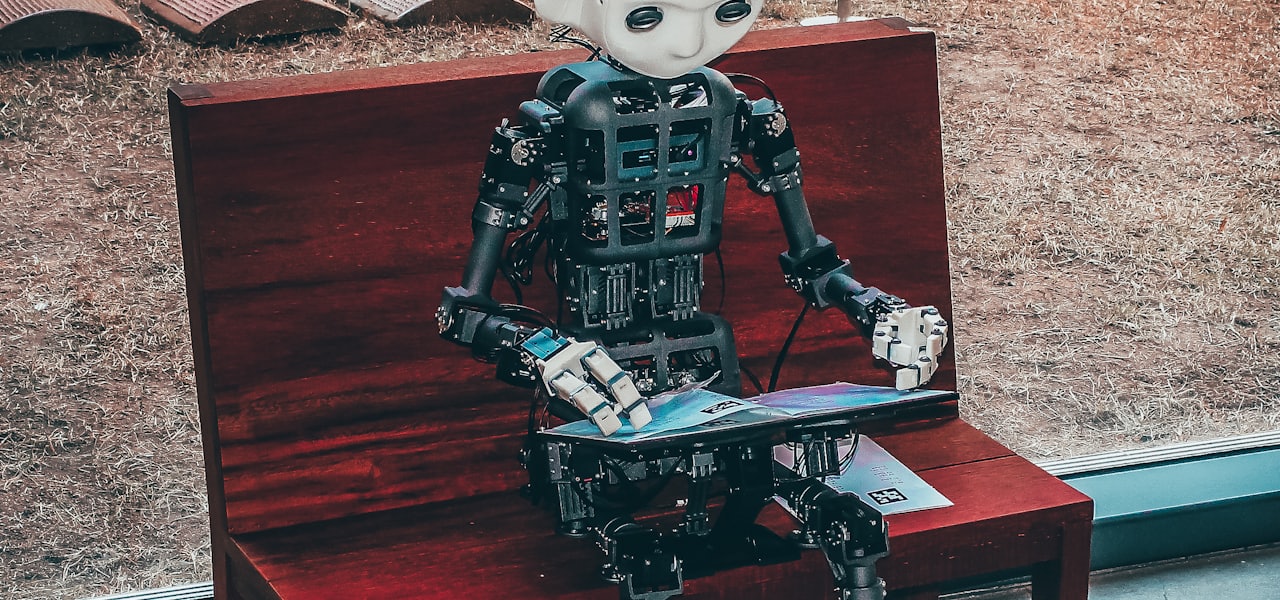
    Human-Robot Collaboration is the study of collaborative processes in human and robot agents work together to achieve shared goals. Many new applications for robots require them to work alongside people as capable members of human-robot teams. These include robots for homes, hospitals, and offices, space exploration and manufacturing. Human-Robot Collaboration (HRC) is an interdisciplinary research area comprising classical robotics, human-computer interaction, artificial intelligence, process design, layout planning, ergonomics, cognitive sciences, and psychology. Industrial applications of human-robot collaboration involve Collaborative Robots, or cobots, that physically interact with humans in a shared workspace to complete tasks such as collaborative manipulation or object handovers. == Collaborative Activity == Collaboration is defined as a special type of coordinated activity, one in which two or more agents work jointly with each other, together performing a task or carrying out the activities needed to satisfy a shared goal. The process typically involves shared plans, shared norms and mutually beneficial interactions. Although collaboration and cooperation are often used interchangeably, collaboration differs from cooperation as it involves a shared goal and joint action where the success of both parties depend on each other. For effective human-robot collaboration, it is imperative that the robot is capable of understanding and interpreting several communication mechanisms similar to the mechanisms involved in human-human interaction. The robot must also communicate its own set of intents and goals to establish and maintain a set of shared beliefs and to coordinate its actions to execute the shared plan. In addition, all team members demonstrate commitment to doing their own part, to the others doing theirs, and to the success of the overall task. == Theories Informing Human-Robot Collaboration == Human-human collaborative activities are studied in depth in order to identify the characteristics that enable humans to successfully work together. These activity models usually aim to understand how people work together in teams, how they form intentions and achieve a joint goal. Theories on collaboration inform human-robot collaboration research to develop efficient and fluent collaborative agents. === Belief Desire Intention Model === The belief-desire-intention (BDI) model is a model of human practical reasoning that was originally developed by Michael Bratman. The approach is used in intelligent agents research to describe and model intelligent agents. The BDI model is characterized by the implementation of an agent's beliefs (the knowledge of the world, state of the world), desires (the objective to accomplish, desired end state) and intentions (the course of actions currently under execution to achieve the desire of the agent) in order to deliberate their decision-making processes. BDI agents are able to deliberate about plans, select plans and execute plans. === Shared Cooperative Activity === Shared Cooperative Activity defines certain prerequisites for an activity to be considered shared and cooperative: mutual responsiveness, commitment to the joint activity and commitment to mutual support. An example case to illustrate these concepts would be a collaborative activity where agents are moving a table out the door, mutual responsiveness ensures that movements of the agents are synchronized; a commitment to the joint activity reassures each team member that the other will not at some point drop his side; and a commitment to mutual support deals with possible breakdowns due to one team member's inability to perform part of the plan. === Joint Intention Theory === Joint Intention Theory proposes that for joint action to emerge, team members must communicate to maintain a set of shared beliefs and to coordinate their actions towards the shared plan. In collaborative work, agents should be able to count on the commitment of other members, therefore each agent should inform the others when they reach the conclusion that a goal is achievable, impossible, or irrelevant. == Approaches to Human-Robot Collaboration == The approaches to human-robot collaboration include human emulation (HE) and human complementary (HC) approaches. Although these approaches have differences, there are research efforts to develop a unified approach stemming from potential convergences such as Collaborative Control. === Human Emulation === The human emulation approach aims to enable computers to act like humans or have human-like abilities in order to collaborate with humans. It focuses on developing formal models of human-human collaboration and applying these models to human-computer collaboration. In this approach, humans are viewed as rational agents who form and execute plans for achieving their goals and infer other people's plans. Agents are required to infer the goals and plans of other agents, and collaborative behavior consists of helping other agents to achieve their goals. === Human Complementary === The human complementary approach seeks to improve human-computer interaction by making the computer a more intelligent partner that complements and collaborates with humans. The premise is that the computer and humans have fundamentally asymmetric abilities. Therefore, researchers invent interaction paradigms that divide responsibility between human users and computer systems by assigning distinct roles that exploit the strengths and overcome the weaknesses of both partners. == Key Aspects == Specialization of Roles: Based on the level of autonomy and intervention, there are several human-robot relationships including master-slave, supervisor–subordinate, partner–partner, teacher–learner and fully autonomous robot. In addition to these roles, homotopy (a weighting function that allows a continuous change between leader and follower behaviors) was introduced as a flexible role distribution. Establishing shared goal(s): Through direct discussion about goals or inference from statements and actions, agents must determine the shared goals they are trying to achieve. Allocation of Responsibility and Coordination: Agents must decide how to achieve their goals, determine what actions will be done by each agent, and how to coordinate the actions of individual agents and integrate their results. Shared context: Agents must be able to track progress toward their goals. They must keep track of what has been achieved and what remains to be done. They must evaluate the effects of actions and determine whether an acceptable solution has been achieved. Communication: Any collaboration requires communication to define goals, negotiate over how to proceed and who will do what, and evaluate progress and results. Adaptation and learning: Collaboration over time require partners to adapt themselves to each other and learn from one's partner both directly or indirectly. Time and space: The time-space taxonomy divides human-robot interaction into four categories based on whether the humans and robots are using computing systems at the same time (synchronous) or different times (asynchronous) and while in the same place (collocated) or in different places (non-collocated). Ergonomics: Human factors and ergonomics are one of the key aspects for a sustainable human-robot collaboration. The robot control system can use biomechanical models and sensors to optimize various ergonomic metrics, such as muscle fatigue.

    Read more →
  • Textual entailment

    Textual entailment

    In natural language processing, textual entailment (TE), also known as natural language inference (NLI), is a directional relation between text fragments. The relation holds whenever the truth of one text fragment follows from another text. == Definition == In the TE framework, the entailing and entailed texts are termed text (t) and hypothesis (h), respectively. Textual entailment is not the same as pure logical entailment – it has a more relaxed definition: "t entails h" (t ⇒ h) if, typically, a human reading t would infer that h is most likely true. (Alternatively: t ⇒ h if and only if, typically, a human reading t would be justified in inferring the proposition expressed by h from the proposition expressed by t.) The relation is directional because even if "t entails h", the reverse "h entails t" is much less certain. Determining whether this relationship holds is an informal task, one which sometimes overlaps with the formal tasks of formal semantics (satisfying a strict condition will usually imply satisfaction of a less strict conditioned); additionally, textual entailment partially subsumes word entailment. == Examples == Textual entailment can be illustrated with examples of three different relations: An example of a positive TE (text entails hypothesis) is: text: If you help the needy, God will reward you. hypothesis: Giving money to a poor man has good consequences. An example of a negative TE (text contradicts hypothesis) is: text: If you help the needy, God will reward you. hypothesis: Giving money to a poor man has no consequences. An example of a non-TE (text does not entail nor contradict) is: text: If you help the needy, God will reward you. hypothesis: Giving money to a poor man will make you a better person. == Ambiguity of natural language == A characteristic of natural language is that there are many different ways to state what one wants to say: several meanings can be contained in a single text and the same meaning can be expressed by different texts. This variability of semantic expression can be seen as the dual problem of language ambiguity. Together, they result in a many-to-many mapping between language expressions and meanings. The task of paraphrasing involves recognizing when two texts have the same meaning and creating a similar or shorter text that conveys almost the same information. Textual entailment is similar but weakens the relationship to be unidirectional. Mathematical solutions to establish textual entailment can be based on the directional property of this relation, by making a comparison between some directional similarities of the texts involved. == Approaches == Textual entailment measures natural language understanding as it asks for a semantic interpretation of the text, and due to its generality remains an active area of research. Many approaches and refinements of approaches have been considered, such as word embedding, logical models, graphical models, rule systems, contextual focusing, and machine learning. Practical or large-scale solutions avoid these complex methods and instead use only surface syntax or lexical relationships, but are correspondingly less accurate. As of 2005, state-of-the-art systems are far from human performance; a study found humans to agree on the dataset 95.25% of the time. Algorithms from 2016 had not yet achieved 90%. == Applications == Many natural language processing applications, like question answering, information extraction, summarization, multi-document summarization, and evaluation of machine translation systems, need to recognize that a particular target meaning can be inferred from different text variants. Typically entailment is used as part of a larger system, for example in a prediction system to filter out trivial or obvious predictions. Textual entailment also has applications in adversarial stylometry, which has the objective of removing textual style without changing the overall meaning of communication. == Datasets == Some of available English NLI datasets include: SNLI MultiNLI SciTail SICK MedNLI QA-NLI In addition, there are several non-English NLI datasets, as follows: XNLI DACCORD, RTE3-FR, SICK-FR for French FarsTail for Farsi OCNLI for Chinese SICK-NL for Dutch IndoNLI for Indonesian

    Read more →
  • Shape analysis (digital geometry)

    Shape analysis (digital geometry)

    This article describes shape analysis to analyze and process geometric shapes. == Description == Shape analysis is the (mostly) automatic analysis of geometric shapes, for example using a computer to detect similarly shaped objects in a database or parts that fit together. For a computer to automatically analyze and process geometric shapes, the objects have to be represented in a digital form. Most commonly a boundary representation is used to describe the object with its boundary (usually the outer shell, see also 3D model). However, other volume based representations (e.g. constructive solid geometry) or point based representations (point clouds) can be used to represent shape. Once the objects are given, either by modeling (computer-aided design), by scanning (3D scanner) or by extracting shape from 2D or 3D images, they have to be simplified before a comparison can be achieved. The simplified representation is often called a shape descriptor (or fingerprint, signature). These simplified representations try to carry most of the important information, while being easier to handle, to store and to compare than the shapes directly. A complete shape descriptor is a representation that can be used to completely reconstruct the original object (for example the medial axis transform). == Application fields == Shape analysis is used in many application fields: archeology for example, to find similar objects or missing parts architecture for example, to identify objects that spatially fit into a specific space medical imaging to understand shape changes related to illness or aid surgical planning virtual environments or on the 3D model market to identify objects for copyright purposes security applications such as face recognition entertainment industry (movies, games) to construct and process geometric models or animations computer-aided design and computer-aided manufacturing to process and to compare designs of mechanical parts or design objects. == Shape descriptors == Shape descriptors can be classified by their invariance with respect to the transformations allowed in the associated shape definition. Many descriptors are invariant with respect to congruency, meaning that congruent shapes (shapes that could be translated, rotated and mirrored) will have the same descriptor (for example moment or spherical harmonic based descriptors or Procrustes analysis operating on point clouds). Another class of shape descriptors (called intrinsic shape descriptors) is invariant with respect to isometry. These descriptors do not change with different isometric embeddings of the shape. Their advantage is that they can be applied nicely to deformable objects (e.g. a person in different body postures) as these deformations do not involve much stretching but are in fact near-isometric. Such descriptors are commonly based on geodesic distances measures along the surface of an object or on other isometry invariant characteristics such as the Laplace–Beltrami spectrum (see also spectral shape analysis). There are other shape descriptors, such as graph-based descriptors like the medial axis or the Reeb graph that capture geometric and/or topological information and simplify the shape representation but can not be as easily compared as descriptors that represent shape as a vector of numbers. From this discussion it becomes clear, that different shape descriptors target different aspects of shape and can be used for a specific application. Therefore, depending on the application, it is necessary to analyze how well a descriptor captures the features of interest.

    Read more →
  • ArcSoft ShowBiz

    ArcSoft ShowBiz

    ShowBiz is a video editor by ArcSoft for the Windows operating system. It can create VCD and DVDs and can also export to the formats AVI, MPEG, WMV, and MOV. ShowBiz also contains a DVD burning and menu building feature. As of 2003, it was one of the three most dominant bundled titles. == Reception == PC Magazine reviewer Jan Ozer states: "ArcSoft's ShowBiz has evolved into a competent editor that's generally more usable than Dazzle's MovieStar program, providing more configuration controls, better preview features, and a much greater range of fun effects." John Virata, senior editor of Digital Media Online, says in his three page review of ShowBiz DVD 2, "It is an easy editor to work with and has a logically laid out interface that takes you step by step through the video creation and DVD creation process"

    Read more →
  • Computer-aided lean management

    Computer-aided lean management

    Computer-aided lean management, in business management, is a methodology of developing and using software-controlled, lean systems integration. Its goal is to drive innovation towards cost and cycle-time savings. It attempts to create an efficient use of capital and resources through the development and use of one integrated system model to run a business's planning, engineering, design, maintenance, and operations. == Overview == Computer-Aided Lean Management (CALM) is a management philosophy that uses software to reduce risk and inefficiencies. CALM acts on uncertainties and business inefficiencies to increase profitability through the use of computational decision-making tools that enable opportunities for additional value creation. It is based on the application of software to enable continuous improvement through an Integrated System Model (ISM) of the business’s physical assets, business processes, and machine learning. This integration of software applications using lean principles was developed in the aerospace industry and has migrated to the energy industry. The creation of an ISM removes the barriers posed by the silos or stovepipes inherent in the departmentalization of most companies. Integration enables lean uses of information for the creation of actionable knowledge. CALM strives to create such a lean management approach to running the company through the rigors of software enforcement. From this software enforcement comes clear policy and procedures that are adhered to, activity-based costing, measurement of effectiveness, and the capability of using advanced algorithms for dramatic improvements in optimization of resources. CALM creates business capabilities through software to enable technology application, streamlining of processes, and a lean organizational structure. The methodology is based on a common sense approach for running a business, by measuring actions taken and using those measurements to design more efficient processes. == History == CALM was inspired by lean processes and techniques that were already dominant management technologies with a wide diversity of applications and successes. Motorola and General Electric had been known for the concepts of Six Sigma; Boeing had been managing mass (using modular and flexible assembly options), and Toyota combined elements of these methodologies to create the Toyota Production System. Boeing then took the Toyota model and added computer-aided enforcement of lean methodologies throughout the manufacturing process. One of the major sources for CALM's outgrowth was integrated definition (IDEF) modeling in aerospace manufacturing that was pioneered by the U.S. Air Force in the 1970s. IDEF is a methodology designed to model the end-to-end decisions, actions, and activities of an organization or system so that costs, performance, and cycle times can be optimized. IDEF methods have been adapted for wider use in automotive, aerospace, pharmaceuticals, and software development industries. IDEF methods serve as a starting point to understand lean management through semantic data modeling. The IDEF process begins by mapping the existing functions of an enterprise, creating a graphical model, or road map, that shows what controls each important function, who performs it, what resources are required for carrying it out, what it produces, how much it costs, and what relationships it has to other functions of the organization. IDEF simulations have been found to be efficient at streamlining and modernizing both companies and governmental agencies. Perhaps the best-developed evolution of the IDEF model beyond Toyota was at Boeing. Their project life-cycle process has grown into a rigorous software system that links people, tasks, tools, materials, and the environmental impact of any newly planned project, before any building is allowed to begin. Routinely, more than half of the time for any given project is spent building the precedence diagrams, or three-dimensional process maps, integrating with outside suppliers, and designing the implementation plan–all on the computer. Once real activity is initiated, an action tracker is used to monitor inputs and outputs versus the schedule and delivery metrics in real time throughout the organization. When the execution of a new airplane design begins, it is so well organized that it consistently cuts both costs and build time in half for each successive generation of airframe. Boeing created a complex lean management process called 'define and control airplane configuration/manufacturing resource management' (DCAC/MRM). The process was built with the help of the operations research and computer sciences departments of the University of Pittsburgh. The manufacture of the Boeing 777 was ultimately a success, and it became the precursor to succeeding generations of CALM at Boeing. The methodology of CALM has recently been applied to field orientated infrastructure based businesses with highly interdependent systems, such as electric utilities where a smart grid concept is being researched and developed. The management of infrastructure-based industries like oil, gas, electricity, water, transportation, and renewables requires massive investments in interdependent, physical infrastructure, as well as simultaneous attention to disparate market forces. In infrastructure businesses that manage field assets, uncertainty is the biggest impediment to profitability, rather than the maintenance of efficient supply chains or the management of factory assembly lines. These businesses are dominated by risk from uncertainties such as weather, market variations, transportation disruptions, government actions, logistic difficulties, geology, and asset reliability. CALM has been applied to deal with these types of infrastructure based challenges.

    Read more →
  • Stixel

    Stixel

    In computer vision, a stixel (portmanteau of "stick" and "pixel") is a superpixel representation of depth information in an image, in the form of a vertical stick that approximates the closest obstacles within a certain vertical slice of the scene. Introduced in 2009, stixels have applications in robotic navigation and advanced driver-assistance systems, where they can be used to define a representation of robotic environments and traffic scenes with a medium level of abstraction. == Definition == One of the problems of scene understanding in computer vision is to determine horizontal freespace around the camera, where the agent can move, and the vertical obstacles delimiting it. An image can be paired with depth information (produced e.g. from stereo disparity, lidar, or monocular depth estimation), allowing a dense tridimensional reconstruction of the observed scene. One drawback of dense reconstruction is the large amount of data involved, since each pixel in the image is mapped to an element of a point cloud. Vision problems characterised by planar freespace delimited by mostly vertical obstacles, such as traffic scenes or robotic navigation, can benefit from a condensed representation that allows to save memory and processing time. Stixels are thin vertical rectangles representing a slice of a vertical surface belonging to the closest obstacle in the observed scene. They allow to dramatically reduce the amount of information needed to represent a scene in such problems. A stixel is characterised by three parameters: vertical coordinate of the bottom, height of the stick, and depth. Stixels have fixed width, with each stixel spanning over a certain number of image columns, allowing downsampling of the horizontal image resolution. In the original formulation, each column of the image would contain at most one stixel, and later extensions were developed to allow multiple stixels on each column, allowing to represent multiple objects at different distances. == Stixel estimation == The input to stixel estimation is a dense depth map, that can be computed from stereo disparity or other means. The original approach computes an occupancy grid that can be segmented to estimate the freespace, with dynamic programming providing an efficient method to find an optimal segmentation. Alternative approaches can be used instead of occupancy grid mapping, such as manifold-based methods. The freespace boundary provides the base points of the obstacles at closest longitudinal distance, however multiple objects at different distances might appear in each column of the image. To fully define the obstacles, their height should be estimated, and this is accomplished by segmenting the depth of the object from the depth of the background. A membership function over the pixels can be defined based on the depth value, where the membership represents the confidence of a pixel belonging to the closest vertical obstacle or to the background, and a cut separating the obstacles from the background can again be computed effectively with dynamic programming. Once both the freespace and the obstacle height are known, the stixels can be estimated by fusing the information over the columns spanned by each stixel, and finally a refined depth of the stixel can be estimated via model fitting over the depth of the pixels covered by the stixel, possibly paired with confidence information (e.g. disparity confidence produced by methods such as semi-global matching).

    Read more →
  • ISSCO Graphics

    ISSCO Graphics

    Integrated Software Systems Corporation (ISSCO), doing business as ISSCO Graphics, was an American software developer and publisher based in San Diego, California, and active from 1970 to 1986. They were best known for their enterprise graphics software packages, including Tellagraf, CueChart and Disspla. == History == ISSCO Graphics had considered acquiring Breakthrough Software, whose software focus involved PC DOS, as a means of getting into the PC arena, but backed off when Computer Associates made an offer to acquire ISSCO. By early 1987 it was reported that "Issco users breathe sigh of relief" that all was well. The ISSCO User's Group was founded in 1976. ISSCO, which was founded in 1970 by Peter Preuss, was acquired by Computer Associates in 1986. == Notable products == === Tellagraf === ISSCO's Tellagraf is an early software package designed to allow end-users to "turn out full color, professional quality charts" with initial results displayed on a screen, modified as needed, and then "a final 'hard-copy' can be made .. or made into 35mm color transparencies for projection onto a screen." Users of Tellagraf often had access to CueChart and Disspla software. Often computer sites having one had all three. Terminals with varying degrees of graphics, such as the DEC's VT100 and Tektronix's Tektronix 4xxx family of text and graphics terminals. were supported, and the software ran on popular computing platforms. Four years are important to Tellagraf's early history: 1978: ease of use 1980: graphic-artist quality 1982: introduction of CueChart, and recognition by IEEE. 1983: "quality graphics enters the mainstream of data processing with ..." Tellegraf was eventually acquired by Computer Associates and renamed CA-Tellegraf. SAS users found it helpful. Universities, research institutes and financial services firms were among early users. === Disspla === Disspla is a package of data plotting subroutines that can be used from high level languages. It was also acquired by Computer Associates. === Tellaplan === In 1983 ISSCO introduced Tellaplan, "a project planning, report and schedule charting system for Tell-A- Graf users in IBM MVS or CMS or Digital Equipment Corp. VAX computers" atop which they built "two visual project management software packages" three years later.

    Read more →
  • Flo (app)

    Flo (app)

    Flo is a period-tracking app that provides menstrual cycle, ovulation and pregnancy tracking as well as perimenopause symptom tracking that was developed by Flo Health, Inc. It has over 380 million downloads worldwide and over 70 million monthly active users as of November 2024. In mid-2024, it reached unicorn status, and became Europe’s first femtech unicorn. The company has been accused of sharing users' sensitive health data with third parties without consent and misleading its users about data practices. == History == Flo Health, Inc. was co-founded in 2015 by Dmitry and Yuri Gurski, in Belarus. Their backgrounds helped build the first version of the software having experience in other fitness and health apps. Dmitry serves as the company's CEO. The company's development hubs are in London, Amsterdam and Vilnius. In 2016, the company raised $1 million in seed round funding from Flint Capital and Haxus Venture Fund. In 2017, Flo received an investment of $5 million from Flint Capital and model Natalia Vodianova with Vodianova helping develop an awareness campaign for the company. In 2018, Flo received an investment of $6 million from Mangrove Capital Partners, with participation from Flint Capital and Haxus, giving the company a valuation of $200 million. In mid-2019, Flo received an additional investment of $7.5 million led by Founders Fund. In 2020, the Federal Trade Commission alleged that Flo had misled users about its handling of health information to third parties including Google, Facebook, AppsFlyer, and Flurry since 2016. These allegations followed a 2019 report by The Wall Street Journal in reference to Facebook. The company reached a settlement in 2021 and was required to notify users of how their personal information was shared and obtain permission before any further information was shared. The agreement also required that Flo to undertake an independent privacy audit which it completed in March 2022. In early September 2021, Flo announced it closed $50M in a Series B financing, bringing the total capital raised to $65 million and company valuation to $800M led by VNV Global and Target Global. In March 2024, the Supreme Court of British Columbia certified a class action suit against Flo for sharing intimate data with Facebook and other third parties without user knowledge. In July 2024, Flo announced it raised more than $200M in Series C financing from General Atlantic bringing its valuation beyond $1 billion. As of November 2024, the app had over 380 million downloads world wide, and over 70 million monthly active users. In 2025, Flo adopted a data intelligence platform from Databricks to power its analytics and AI features, allowing users personalized cycle predictions. In 2025, a class action lawsuit in California was settled for $56 million with Flo paying $8 million and Google paying $48 million. == Features and privacy == Flo was initially created as a period and ovulation tracking application. It now provides reminders of upcoming menstrual cycles and a place to record various other health symptoms such as contraceptive methods, vaginal discharge (leukorrhea), water intake, pains, mood swings, and sexual activity. The application is available on iOS and Android. Flo is free to download and the free basic version gives you access to period and ovulation tracking and predictions, symptom tracking, cycle history, and anonymous mode. In Pregnancy mode, the app provides tracking features and educational material for pregnancy. In October 2023, Flo launched Flo for Partners, a feature that allows users to share their Flo data with their partner. In September 2022, as a response to Roe v. Wade being overturned, Flo sped up the release of a feature called "Anonymous Mode". Flo said this mode allows users to access the app without any personal identifiers such as name, email address, or technical identifiers being associated with their health data. Flo said it uses a technology called Oblivious HTTP to help protect user privacy in Anonymous Mode. == Recognition == Flo was named to Bloomberg’s Top 25 UK Startups to Watch for 2024. Flo's Anonymous Mode feature was recognized on both Fast Company's World Changing Ideas 2023 and TIME's Best Inventions List 2023. Flo is a CES 2019 Innovation Awards Honoree in the Software and Mobile Applications category.

    Read more →
  • Dispo

    Dispo

    Dispo (formerly David's Disposable) is an American photo sharing and social networking app owned by Dispo, Inc. and co-founded by CEO Daniel Liss, YouTuber David Dobrik, and Natalie Mariduena. When the app initially launched on iOS in December 2019, it briefly charted as the most downloaded free app on the App Store, ahead of both Disney+ and Instagram. The app was rebranded and relaunched as Dispo, expanding from a simple camera app to a full social network in March 2021. It is based on the disposable camera. == History == On December 21, 2019, the app was first launched on the App Store under the name "David's Disposable." In its first week of release, it was downloaded more than a million times, reaching number one among free apps in the App Store. In June 2020, the team decided to rename the app to Dispo, purchasing the Dispo.fun domain on June 21, 2020. The company announced the change in September 2020. The early Dispo team consisted of Dobrik's longtime friend and business associate Natalie Mariduena as its treasurer, entrepreneur and venture capitalist Daniel Liss as chief executive officer, Regynald Augustin as first engineer, and Briana Hokanson as lead designer. In October 2020, the company raised a $4M seed round with backing from Alexis Ohanian's venture fund Seven Seven Six alongside other investors including Unshackled Ventures, Shrug Capital, and Weekend Fund. In February 2021, Axios reported that the app had generated US$20 million in its series A round, led by Spark Capital. At this time, the app was valued at US$200 million. A New York Times profile asked, "Are Disposables the Future of Photosharing?" In March 2021, the app was officially relaunched with new social network features and its invite-only feature was dropped. On March 21, 2021, it was announced that Spark Capital would sever all ties with Dispo in light of several disparaging allegations against David Dobrik and The Vlog Squad. The same day, it was announced that Dobrik would leave the company and step down from the company's board of directors. On March 22, 2021, Seven Seven Six and Unshackled Ventures announced they would be standing by the company and its remaining employees but donating profits to charity. In June, 2021, CEO Daniel Liss announced Dispo's official Series A. Investors and advisors in the new Dispo include Ohanian's Seven Seven Six, Unshackled, Endeavor, photographers Annie Leibovitz and Raven B. Varona, NBA stars Kevin Durant and Andre Iguodala (through their 35 Ventures and F9 Strategies venture firms, respectively). Other participants include Cara Delevingne, Sofia Vergara, Shade Room CEO Angelica Nwandu, Latin World Entertainment CEO Luis Balaguer, and Amplify Africa co-founders Damilare Kujembola and Timi Adeyeba. == Overview == Dispo has been compared to other image sharing and social networking services, most notably Instagram and VSCO, although users cannot immediately see the photos they have taken using the app. When a user attempts to take a photo, the interface mimics the developing process of a disposable camera. Users can take as many photos on the app as they want; they do not appear on the app however, until 9 am the next day. Once the set of photos appear on the app, users can choose to save them or share them with other users in a "roll". == Reception == Screen Rant has called the app "like Clubhouse [referring to the app] but for photos," comparing the early invite-only features of the apps. As it greatly restricts the user's editing options and sets out to offer a more authentic social networking experience, the app has been widely dubbed the "anti-Instagram". Between March 2021 and June 2021, the app reached the top ten in the App Store's photo/video rankings on 5 continents including in the US, Japan, Spain, Germany, Brazil, and Australia. It has been a notable success in Japan, where it opened its first international office in July 2021. In July 2021, NBA number one draft pick Cade Cunningham announced he had selected Dispo as his exclusive social media partner for the NBA draft.

    Read more →
  • ImageMixer

    ImageMixer

    ImageMixer is a brand name of video editing software that edits digital video and still image in camcorders and authors to VCD and DVD. It is a second-party Japanese product, distributed by Pixela Corporation, a Japanese manufacturer of PC peripheral hardware and multimedia software. == Bundling == ImageMixer is widely used for several camcorder brands, such as JVC, Hitachi and Canon. Also, Sony has chosen to package ImageMixer with its DVD and HDD Handycam. == ImageMixer series == ImageMixer has other series of software for digital camera, such as ImageMixer Label Maker and ImageMixer DVD dubbing. ImageMixer also has movie editing solution for Macintosh. == Windows Vista version of ImageMixer == A Windows Vista version of ImageMixer has been developed (ImageMixer3).

    Read more →
  • Haskins Laboratories

    Haskins Laboratories

    Haskins Laboratories, Inc. is an independent research laboratory, founded in 1935 and located in New Haven, Connecticut since 1970. Many current Haskins researchers are affiliated with Yale University's Child Study Center and/or the University of Connecticut. Haskins is a multidisciplinary and international community of researchers who conduct basic research on spoken and written language and global literacy. A guiding perspective of their research has been to view speech and language as emerging from biological processes, including those of adaptation, response to stimuli, and conspecific interaction. Haskins Laboratories has a long history of technological and theoretical innovation, from creating systems of rules for speech synthesis and development of an early working prototype of a reading machine for the blind to developing the landmark concept of phonemic awareness as the critical preparation for learning to read an alphabetic writing system. == Research tools and facilities == Haskins Laboratories is equipped, in-house, with a comprehensive suite of tools and capabilities to advance its mission of research into language and literacy. As of 2014, these included: Anechoic chamber Electroencephalography BioSemi 264 electrode, 24 bit Active Two System EGI 128 electrode, Geodesic EEG System 300 Electromagnetic articulography (EMMA) Carstens AG501 NDI WAVE Eye tracking: HL is equipped with 3 SR Research eye-trackers. 2 Model Eyelink 1000 systems. 1 Model Eyelink 1000plus system. Magnetic resonance imaging: Haskins has access to MRI scanners through agreements with the University of Connecticut and the Yale School of Medicine. On-site, HL has a Linux computer cluster dedicated to analysis of MRI data. Motion capture: HL is equipped with a Vicon motion capture system with one Basler high-speed digital camera, six Vicon MX T-20 cameras and a Vicon MX Giganet for synching camera data and connecting cameras to the data capture computer. Near infrared spectroscopy: HL has a TechEn CW6 8x8 system (four emitters; eight detectors). Ultrasound sonogram == History == Many researchers have contributed to scientific breakthroughs at Haskins Laboratories since its founding. All of them are indebted to the pioneering work and leadership of Caryl Parker Haskins, Franklin S. Cooper, Alvin Liberman, Seymour Hutner and Luigi Provasoli. The history presented here focuses on the research program of the division of Haskins Laboratories that, since the 1940s, has been most well known for its work in the areas of speech, language, and reading. === 1930s === Caryl Haskins and Franklin S. Cooper established Haskins Laboratories in 1935. It was originally affiliated with Harvard University, MIT, and Union College in Schenectady, NY. Caryl Haskins conducted research in microbiology, radiation physics, and other fields in Cambridge, MA and Schenectady. In 1939 Haskins Laboratories moved its center to New York City. Seymour Hutner joined the staff to set up a research program in microbiology, genetics, and nutrition. The descendant of the division led by Hutner program eventually became a department of Pace University in New York. The two identically named organizations are no longer formally affiliated. === 1940s === The U. S. Office of Scientific Research and Development, under Vannevar Bush asked Haskins Laboratories to evaluate and develop technologies for assisting blinded World War II veterans. Experimental psychologist Alvin Liberman joined Haskins Laboratories to assist in developing a "sound alphabet" to represent the letters in a text for use in a reading machine for the blind. Luigi Provasoli joined Haskins Laboratories to set up a research program in marine biology. The program in marine biology moved to Yale University in 1970 and disbanded with Provasoli's retirement in 1978. === 1950s === Franklin S. Cooper invented the pattern playback, a machine that converts pictures of the acoustic patterns of speech back into sound. With this device, Alvin Liberman, Cooper, and Pierre Delattre (and later joined by Katherine Safford Harris, Leigh Lisker, Arthur Abramson, and others), discovered the acoustic cues for the perception of phonetic segments (consonants and vowels). Liberman and colleagues proposed a motor theory of speech perception to resolve the acoustic complexity: they hypothesized that we perceive speech by tapping into a biological specialization, a speech module, that contains knowledge of the acoustic consequences of articulation. Liberman, aided by Frances Ingemann and others, organized the results of the work on speech cues into a groundbreaking set of rules for speech synthesis by the Pattern Playback. === 1960s === Franklin S. Cooper and Katherine Safford Harris, working with Peter MacNeilage, were the first researchers in the U.S. to use electromyographic techniques, pioneered at the University of Tokyo, to study the neuromuscular organization of speech. Leigh Lisker and Arthur Abramson looked for simplification at the level of articulatory action in the voicing of certain contrasting consonants. They showed that many acoustic properties of voicing contrasts arise from variations in voice onset time, the relative phasing of the onset of vocal cord vibration and the end of a consonant. Their work has been widely replicated and elaborated, here and abroad, over the following decades. Donald Shankweiler and Michael Studdert-Kennedy used a dichotic listening technique (presenting different nonsense syllables simultaneously to opposite ears) to demonstrate the dissociation of phonetic (speech) and auditory (nonspeech) perception by finding that phonetic structure devoid of meaning is an integral part of language, typically processed in the left cerebral hemisphere. Liberman, Cooper, Shankweiler, and Studdert-Kennedy summarized and interpreted fifteen years of research in "Perception of the Speech Code", still among the most cited papers in the speech literature. It set the agenda for many years of research at Haskins and elsewhere by describing speech as a code in which speakers overlap (or coarticulate) segments to form syllables. Researchers at Haskins connected their first computer to a speech synthesizer designed by Haskins Laboratories' engineers. Ignatius Mattingly, with British collaborators, John N. Holmes and J.N. Shearme, adapted the Pattern playback rules to write the first computer program for synthesizing continuous speech from a phonetically spelled input. A further step toward a reading machine for the blind combined Mattingly's program with an automatic look-up procedure for converting alphabetic text into strings of phonetic symbols. === 1970s === In 1970, Haskins Laboratories moved to New Haven, Connecticut, and entered into affiliation agreements with Yale University and the University of Connecticut; Haskins remains fully independent of both Yale and UConn, administratively and financially. The lab's original location in New Haven, at 270 Crown Street (from 1970 to 2005), was leased from Yale University. Isabelle Liberman, Donald Shankweiler, and Alvin Liberman teamed up with Ignatius Mattingly to study the relationship between speech perception and reading, a topic implicit in Haskins Laboratories' research program since its inception. They developed the concept of phonemic awareness, the knowledge that would-be readers must be aware of the phonemic structure of their language in order to be able to read. Leonard Katz related the work to contemporary cognitive theory and provided expertise in experimental design and data analysis. Under the broad rubric of the "alphabetic principle", this is the core of the lab's present program of reading pedagogy. Patrick Nye joined Haskins Laboratories to lead a team working on the reading machine for the blind. The project culminated when the addition of an optical character recognizer allowed investigators to assemble the first automatic text-to-speech reading machine. By the end of the decade this technology had advanced to the point where commercial concerns assumed the task of designing and manufacturing reading machines for the blind. In 1973, Franklin S. Cooper was selected to form a panel of six experts charged with investigating the famous 18-minute gap in the White House office tapes of President Richard Nixon related to the Watergate scandal. Building on earlier work, Philip Rubin developed the sinewave synthesis program, which was then used by Robert Remez, Rubin, and colleagues to show that listeners can perceive continuous speech without traditional speech cues from a pattern of sinewaves that track the changing resonances of the vocal tract. This paved the way for a view of speech as a dynamic pattern of trajectories through articulatory-acoustic space. Philip Rubin and colleagues developed Paul Mermelstein's anatomically simplified vocal tract model, originally worked on at Bell Laboratories, into the first articulatory synthesizer that can be controlled in a phy

    Read more →
  • EffectsLab Pro

    EffectsLab Pro

    EffectsLab Pro is a discontinued visual effects software product developed by FXhome. It has since been superseded by the FXhome HitFilm range. The company also produced a limited functionality version, EffectsLab Lite, containing just the Particle engine. A more extensive product, VisionLab Studio, combined the functionality of EffectsLab Pro and the company's CompositeLab Pro product with enhancements to both. == Effects Engines == The effects are generated by the program's effect engines: The Neon Light engine allows light beams to be drawn onto the video, allowing the generation of lightsaber-like weapons, neon lighting, fantasy glow effects and laser blasts. The Particle engine is used for particle effects, such as smoke, fire, explosions, and weather effects. The Muzzle Flash engine is designed for creating and animating muzzle flashes such as machine gun firing, tank blasts, etc. It's possible to rotate the created muzzle flash in 3D, making it the only engine with 3D use. The Optics engine is designed for creating artificial lens flares and light sources. It is useful for enhancing other light-based effects, and mimicking the distinctive flashes of light that accompany Star Wars' lightsaber battles. The Laser engine (introduced in EffectsLab Pro in late 2007) is designed as a simplified method of creating laser weapon effects, including the ability to add simulated perspective to the effect. == Presets == EffectsLab Pro allows the user to save the effects using presets. Since all effects are generated from settings in the different engines, it is fairly easy to generate an XML style description of the effect. It is also possible to share presets on FXhome's website.

    Read more →