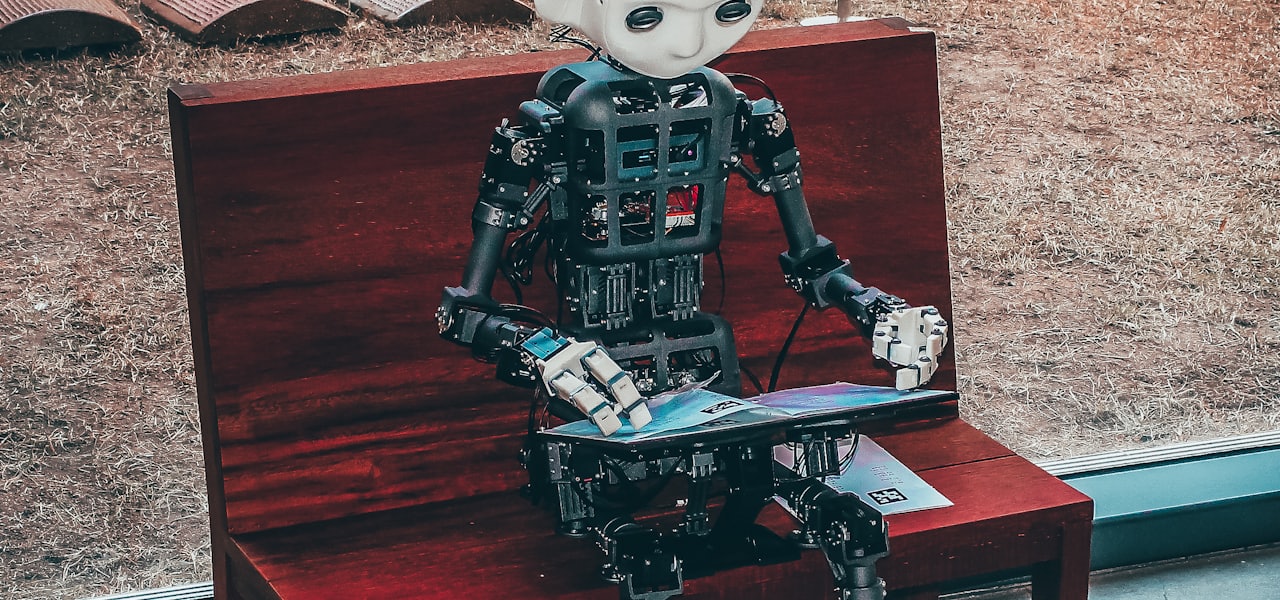
In computer science, computational intelligence (CI) refers to concepts, paradigms, algorithms and implementations of systems that are designed to show "intelligent" behavior in complex and changing environments. These systems are aimed at mastering complex tasks in a wide variety of technical or commercial areas and offer solutions that recognize and interpret patterns, control processes, support decision-making or autonomously manoeuvre vehicles or robots in unknown environments, among other things. These concepts and paradigms are characterized by the ability to learn or adapt to new situations, to generalize, to abstract, to discover and associate. Nature-analog or nature-inspired methods play a key role in this. CI approaches primarily address those complex real-world problems for which traditional or mathematical modeling is not appropriate for various reasons: the processes cannot be described exactly with complete knowledge, the processes are too complex for mathematical reasoning, they contain some uncertainties during the process, such as unforeseen changes in the environment or in the process itself, or the processes are simply stochastic in nature. Thus, CI techniques are properly aimed at processes that are ill-defined, complex, nonlinear, time-varying and/or stochastic. A recent definition of the IEEE Computational Intelligence Societey describes CI as the theory, design, application and development of biologically and linguistically motivated computational paradigms. Traditionally the three main pillars of CI have been Neural Networks, Fuzzy Systems and Evolutionary Computation. ... CI is an evolving field and at present in addition to the three main constituents, it encompasses computing paradigms like ambient intelligence, artificial life, cultural learning, artificial endocrine networks, social reasoning, and artificial hormone networks. ... Over the last few years there has been an explosion of research on Deep Learning, in particular deep convolutional neural networks. Nowadays, deep learning has become the core method for artificial intelligence. In fact, some of the most successful AI systems are based on CI. However, as CI is an emerging and developing field there is no final definition of CI, especially in terms of the list of concepts and paradigms that belong to it. The general requirements for the development of an “intelligent system” are ultimately always the same, namely the simulation of intelligent thinking and action in a specific area of application. To do this, the knowledge about this area must be represented in a model so that it can be processed. The quality of the resulting system depends largely on how well the model was chosen in the development process. Sometimes data-driven methods are suitable for finding a good model and sometimes logic-based knowledge representations deliver better results. Hybrid models are usually used in real applications. According to actual textbooks, the following methods and paradigms, which largely complement each other, can be regarded as parts of CI: Fuzzy systems Neural networks and, in particular, convolutional neural networks Evolutionary computation and, in particular, multi-objective evolutionary optimization Swarm intelligence Bayesian networks Artificial immune systems Learning theory Probabilistic methods == Relationship between hard and soft computing and artificial and computational intelligence == Artificial intelligence (AI) is used in the media, but also by some of the scientists involved, as a kind of umbrella term for the various techniques associated with it or with CI. Craenen and Eiben state that attempts to define or at least describe CI can usually be assigned to one or more of the following groups: "Relative definition” comparing CI to AI Conceptual treatment of key notions and their roles in CI Listing of the (established) areas that belong to it The relationship between CI and AI has been a frequently discussed topic during the development of CI. While the above list implies that they are synonyms, the vast majority of AI/CI researchers working on the subject consider them to be distinct fields, where either CI is an alternative to AI AI includes CI CI includes AI The view of the first of the above three points goes back to Zadeh, the founder of the fuzzy set theory, who differentiated machine intelligence into hard and soft computing techniques, which are used in artificial intelligence on the one hand and computational intelligence on the other. In hard computing (HC) and traditional AI (e.g. expert systems), inaccuracy and uncertainty are undesirable characteristics of a system, while soft computing (SC) and thus CI focus on dealing with these characteristics. The adjacent figure illustrates this view and lists the most important CI techniques. Another frequently mentioned distinguishing feature is the representation of information in symbolic form in AI and in sub-symbolic form in CI techniques. Hard computing is a conventional computing method based on the principles of certainty and accuracy and it is deterministic. It requires a precisely stated analytical model of the task to be processed and a prewritten program, i.e. a fixed set of instructions. The models used are based on Boolean logic (also called crisp logic), where e.g. an element can be either a member of a set or not and there is nothing in between. When applied to real-world tasks, systems based on HC result in specific control actions defined by a mathematical model or algorithm. If an unforeseen situation occurs that is not included in the model or algorithm used, the action will most likely fail. Soft computing, on the other hand, is based on the fact that the human mind is capable of storing information and processing it in a goal-oriented way, even if it is imprecise and lacks certainty. SC is based on the model of the human brain with probabilistic thinking, fuzzy logic and multi-valued logic. Soft computing can process a wealth of data and perform a large number of computations, which may not be exact, in parallel. For hard problems for which no satisfying exact solutions based on HC are available, SC methods can be applied successfully. SC methods are usually stochastic in nature i.e., they are a randomly defined processes that can be analyzed statistically but not with precision. Up to now, the results of some CI methods, such as deep learning, cannot be verified and it is also not clear what they are based on. This problem represents an important scientific issue for the future. AI and CI are catchy terms, but they are also so similar that they can be confused. The meaning of both terms has developed and changed over a long period of time, with AI being used first. Bezdek describes this impressively and concludes that such buzzwords are frequently used and hyped by the scientific community, science management and (science) journalism. Not least because AI and biological intelligence are emotionally charged terms and it is still difficult to find a generally accepted definition for the basic term intelligence. == History == In 1950, Alan Turing, one of the founding fathers of computer science, developed a test for computer intelligence known as the Turing test. In this test, a person can ask questions via a keyboard and a monitor without knowing whether his counterpart is a human or a computer. A computer is considered intelligent if the interrogator cannot distinguish the computer from a human. This illustrates the discussion about intelligent computers at the beginning of the computer age. The term Computational Intelligence was first used as the title of the journal of the same name in 1985 and later by the IEEE Neural Networks Council (NNC), which was founded 1989 by a group of researchers interested in the development of biological and artificial neural networks. On November 21, 2001, the NNC became the IEEE Neural Networks Society, to become the IEEE Computational Intelligence Society two years later by including new areas of interest such as fuzzy systems and evolutionary computation. The NNC helped organize the first IEEE World Congress on Computational Intelligence in Orlando, Florida in 1994. On this conference the first clear definition of Computational Intelligence was introduced by Bezdek: A system is computationally intelligent when it: deals with only numerical (low-level) data, has pattern-recognition components, does not use knowledge in the AI sense; and additionally when it (begins to) exhibit (1) computational adaptivity; (2) computational fault tolerance; (3) speed approaching human-like turnaround and (4) error rates that approximate human performance. Today, with machine learning and deep learning in particular utilizing a breadth of supervised, unsupervised, and reinforcement learning approaches, the CI landscape has been greatly enhanced, with novell intelligent approaches. == The main algorithmic approaches of CI and their applicati
Crucible (software)
Crucible is a collaborative code review application by Australian software company Atlassian. Like other Atlassian products, Crucible is a Web-based application primarily aimed at enterprise, and certain features that enable peer review of a codebase may be considered enterprise social software. Crucible is particularly tailored to remote workers, and facilitates asynchronous review and commenting on code. Crucible also integrates with popular source control tools, such as Git and Subversion. Crucible is not open source, but customers are allowed to view and modify the code for their own use.
Reflection lines
Engineers use reflection lines to judge a surface's quality. Reflection lines reveal surface flaws, particularly discontinuities in normals indicating that the surface is not C 2 {\displaystyle C^{2}} . Reflection lines may be created and examined on physical surfaces or virtual surfaces with the help of computer graphics. For example, the shiny surface of an automobile body is illuminated with reflection lines by surrounding the car with parallel light sources. Virtually, a surface can be rendered with reflection lines by modulating the surfaces point-wise color according to a simple calculation involving the surface normal, viewing direction and a square wave environment map. == Mathematical definition == Consider a point p {\displaystyle p} on a surface M {\displaystyle M} with (normalized) normal n {\displaystyle n} . If an observer views this point from infinity at view direction v {\displaystyle v} then the reflected view direction r {\displaystyle r} is: r = v − 2 ( n ⋅ v ) n . {\displaystyle r=v-2(n\cdot v)n.} (The vector v {\displaystyle v} is decomposed into its normal part v n = ( n ⋅ v ) v {\displaystyle v_{n}=(n\cdot v)v} and tangential part v t = v − v n {\displaystyle v_{t}=v-v_{n}} . Upon reflection, the tangential part is kept and the normal part is negated.) For reflection lines we consider the surface M {\displaystyle M} surrounded by parallel lines with direction a {\displaystyle a} , representing infinite, non-dispersive light sources. For each point p {\displaystyle p} on M {\displaystyle M} we determine which line is seen from direction v {\displaystyle v} . The position on each line is of no interest. Define the vector r p {\displaystyle r_{p}} to be the reflection direction r {\displaystyle r} projected onto a plane P {\displaystyle P} that is orthogonal to a {\displaystyle a} : r p = r − ( r ⋅ a ) a {\displaystyle r_{p}=r-(r\cdot a)a} and similarly let v p {\displaystyle v_{p}} be the viewing direction projected onto P {\displaystyle P} : v p = v − ( v ⋅ a ) a {\displaystyle v_{p}=v-(v\cdot a)a} Finally, define v o {\displaystyle v_{o}} to be the direction lying in P {\displaystyle P} perpendicular to a {\displaystyle a} and v p {\displaystyle v_{p}} : v o = a × v p {\displaystyle v_{o}=a\times v_{p}} Using these vectors, the reflection line function θ ( p ) : M → ( − π , π ] {\displaystyle \theta (p):M\rightarrow (-\pi ,\pi ]} is a scalar function mapping points p {\displaystyle p} on the surface to angles between v p {\displaystyle v_{p}} and r p {\displaystyle r_{p}} : θ = arctan ( r p ⋅ v o , r p ⋅ v p ) {\displaystyle \theta =\arctan {(r_{p}\cdot v_{o},r_{p}\cdot v_{p})}} where a r c t a n ( y , x ) {\displaystyle arctan(y,x)} is the atan2 function producing a number in the range ( − π , π ] {\displaystyle (-\pi ,\pi ]} . ( v p {\displaystyle v_{p}} and v o {\displaystyle v_{o}} can be viewed as a local coordinate system in P {\displaystyle P} with x {\displaystyle x} -axis in direction v p {\displaystyle v_{p}} and y {\displaystyle y} -axis in direction v o {\displaystyle v_{o}} .) Finally, to render the reflection lines positive values θ > 0 {\displaystyle \theta >0} are mapped to a light color and non-positive values to a dark color. == Highlight lines == Highlight lines are a view-independent alternative to reflection lines. Here the projected normal is directly compared against some arbitrary vector x {\displaystyle x} perpendicular to the light source: θ = arctan ( n a ⋅ a ⊥ , n a ⋅ x ) {\displaystyle \theta =\arctan {(n_{a}\cdot a^{\perp },n_{a}\cdot x)}} where n a {\displaystyle n_{a}} is the surface normal projected on the light source plane P {\displaystyle P} : n a ^ / | n a ^ | , n a ^ = n − ( n ⋅ a ) a {\displaystyle {\hat {n_{a}}}/|{\hat {n_{a}}}|,{\hat {n_{a}}}=n-(n\cdot a)a} The relationship between reflection lines and highlight lines is likened to that between specular and diffuse shading.
Vanish (computer science)
Vanish was a project to "give users control over the lifetime of personal data stored on the web." It was led by Roxana Geambasu at the University of Washington. The project proposed to allow a user to enter information to send across the internet, thereby relinquishing control of it. However, the user can include an "expiration date," after which the information is no longer usable by anyone who may have a copy of it, even the creator. The Vanish approach was found to be vulnerable to a Sybil attack and thus insecure by a team called Unvanish from the University of Texas, University of Michigan, and Princeton. == Theory == Vanish acts by automating the encryption of information entered by the user with an encryption key that is unknown to the user. Along with the information the user enters, the user also enters metadata concerning how long the information should remain available. The system then encrypts the information but does not store either the encryption key or the original information. Instead, it breaks up the decryption key into smaller components that are disseminated across distributed hash tables, or DHTs, via the Internet. The DHTs refresh information within their nodes on a set schedule unless configured to make the information persistent. The time delay entered by the user in the metadata controls how long the DHTs should allow the information to persist, but once that time period is over, the DHTs will reuse those nodes, making the information about the decryption stored irretrievable. As long as the decryption key may be reassembled from the DHTs, the information is retrievable. However, once the period entered by the user has lapsed, the information is no longer recoverable, as the user never possessed the decryption key. == Implementation == Vanish currently exists as a Firefox plug-in which allows a user to enter text into either a standard Gmail email or Facebook message and choose to send the message via Vanish. The message is then encrypted and sent via the normal networking pathways through the cloud to the recipient. The recipient must have the same Firefox plug-in to decrypt the message. The plugin accesses BitTorrent DHTs, which have 8-hour lifespans. This means the user may select an expiration date for the message in increments of 8 hours. After the expiration of the user-defined time span, the information in the DHT is overwritten, thereby eliminating the key. While both the user and recipient may have copies of the original encrypted message, the key used to turn it back into plain text is now gone. Although this particular instance of the data has become inaccessible, it's important to note that the information can always be saved by other means before expiration (copied or even via screen shots) and published again.
Data remanence
Data remanence is the residual representation of digital data that remains even after attempts have been made to remove or erase the data. This residue may result from data being left intact by a nominal file deletion operation, by reformatting of storage media that does not remove data previously written to the media, or through physical properties of the storage media that allow previously written data to be recovered. Data remanence may make inadvertent disclosure of sensitive information possible should the storage media be released into an uncontrolled environment (e.g., thrown in refuse containers or lost). Various techniques have been developed to counter data remanence. These techniques are classified as clearing, purging/sanitizing, or destruction. Specific methods include overwriting, degaussing, encryption, and media destruction. Effective application of countermeasures can be complicated by several factors, including media that are inaccessible, media that cannot effectively be erased, advanced storage systems that maintain histories of data throughout the data's life cycle, and persistence of data in memory that is typically considered volatile. Several standards exist for the secure removal of data and the elimination of data remanence. == Causes == Many operating systems, file managers, and other software provide a facility where a file is not immediately deleted when the user requests that action. Instead, the file is moved to a holding area (i.e. the "trash"), making it easy for the user to undo a mistake. Similarly, many software products automatically create backup copies of files that are being edited, to allow the user to restore the original version, or to recover from a possible crash (autosave feature). Even when an explicit deleted file retention facility is not provided or when the user does not use it, operating systems do not actually remove the contents of a file when it is deleted unless they are aware that explicit erasure commands are required, like on a solid-state drive. (In such cases, the operating system will issue the Serial ATA TRIM command or the SCSI UNMAP command to let the drive know to no longer maintain the deleted data.) Instead, they simply remove the file's entry from the file system directory because this requires less work and is therefore faster, and the contents of the file—the actual data—remain on the storage medium. The data will remain there until the operating system reuses the space for new data. In some systems, enough filesystem metadata are also left behind to enable easy undeletion by commonly available utility software. Even when undelete has become impossible, the data, until it has been overwritten, can be read by software that reads disk sectors directly. Computer forensics often employs such software. Likewise, reformatting, repartitioning, or reimaging a system is unlikely to write to every area of the disk, though all will cause the disk to appear empty or, in the case of reimaging, empty except for the files present in the image, to most software. Finally, even when the storage media is overwritten, physical properties of the media may permit recovery of the previous contents. In most cases however, this recovery is not possible by just reading from the storage device in the usual way, but requires using laboratory techniques such as disassembling the device and directly accessing/reading from its components. § Complications below gives further explanations for causes of data remanence. == Countermeasures == There are three levels commonly recognized for eliminating remnant data: === Clearing === Clearing is the removal of sensitive data from storage devices in such a way that there is assurance that the data may not be reconstructed using normal system functions or software file/data recovery utilities. The data may still be recoverable, but not without special laboratory techniques. Clearing is typically an administrative protection against accidental disclosure within an organization. For example, before a hard drive is re-used within an organization, its contents may be cleared to prevent their accidental disclosure to the next user. === Purging === Purging or sanitizing is the physical rewrite of sensitive data from a system or storage device done with the specific intent of rendering the data unrecoverable at a later time. Purging, proportional to the sensitivity of the data, is generally done before releasing media beyond control, such as before discarding old media, or moving media to a computer with different security requirements. === Destruction === The storage media is made unusable for conventional equipment. Effectiveness of destroying the media varies by medium and method. Depending on recording density of the media, and/or the destruction technique, this may leave data recoverable by laboratory methods. Conversely, destruction using appropriate techniques is the most secure method of preventing retrieval. == Specific methods == === Overwriting === A common method used to counter data remanence is to overwrite the storage media with new data. This is often called wiping or shredding a disk or file, by analogy to common methods of destroying print media, although the mechanism bears no similarity to these. Because such a method can often be implemented in software alone, and may be able to selectively target only part of the media, it is a popular, low-cost option for some applications. Overwriting is generally an acceptable method of clearing, as long as the media is writable and not damaged. The simplest overwrite technique writes the same data everywhere—often just a pattern of all zeros. At a minimum, this will prevent the data from being retrieved simply by reading from the media again using standard system functions. The UEFI in modern machines may offer an ATA class disk erase function as well. The ATA-6 standard governs secure erases specifications. Bitlocker is whole disk encryption and illegible without the key. Writing a fresh GPT allows a new file system to be established. Blocks will set empty but LBA read is illegible. New data will be unaffected and work fine. In an attempt to counter more advanced data recovery techniques, specific overwrite patterns and multiple passes have often been prescribed. These may be generic patterns intended to eradicate any trace signatures; an example is the seven-pass pattern 0xF6, 0x00, 0xFF,
You.com
You.com is an artificial intelligence search startup that has pivoted away from consumer search engine operations toward business-focused AI tools and APIs. The company was founded in 2020 by Richard Socher, the former chief scientist at Salesforce, and Bryan McCann, a former NLP researcher at Salesforce. == History == Following its 2020 founding, You.com opened its public beta on November 9, 2021, and received $20 million in funding led by Salesforce founder and CEO Marc Benioff. Other investors include Breyer Capital, Sound Ventures, and Day One Ventures. The domain You.com was initially purchased in 1996 by Benioff. Benioff invested in You.com and transferred ownership of the You.com domain name to the company. In July 2022, You.com announced its $25 million Series A funding round led by Radical Ventures with participation from Time Ventures, Breyer Capital, Norwest Venture Partners and Day One Ventures. In September 2024, You.com raised $50 million in Series B funding led by Georgian. In September 2025, You.com raised $100 million in Series C funding led by Cox Enterprises at a $1.5 billion valuation, achieving unicorn status. == Business model == You.com generates revenue primarily through enterprise sales of search APIs and AI tools. The platform provides web search capabilities that can be integrated into enterprise applications and AI agents. == Features == On December 23, 2022, You.com was the first search engine to launch an LLM chatbot with live web results alongside its responses. Initially known as YouChat, the chatbot was primarily based on the GPT-3.5 large language model and could answer questions, suggest ideas, translate text, summarize articles, compose emails, and write code snippets, while staying up-to-date with current events and citing sources. Several further versions of YouChat were released. The second version, called YouChat 2.0, was released on February 7, 2023, incorporated improved conversational AI and community-built applications by blending a large language model named C-A-L (Chat, Apps, and Links). This update enabled YouChat to provide results in various formats, such as charts, photos, videos, tables, graphs, text or code, so users can find answers without leaving the search results page. YouChat 3.0, unveiled on May 4, 2023, combined chat functionality with results from Reddit, TikTok, Stack Overflow and Wikipedia. === YouPro === On June 21, 2023, You.com introduced YouPro, a paid subscription. Both free and paid versions provide access to large language models connected to the internet with citation capabilities. === ARI === In February 2025, You.com launched ARI (Advanced Research and Insights), a deep research agent that scans over 400 sources simultaneously to produce research reports with verified citations and interactive graphs, charts, and visualizations. The platform targets regulated industries where comprehensive source verification is critical, with customers including healthcare publishers and advisory firms. == Reception == You.com was named one of TIME's Best Inventions of 2022. You.com's ARI (Advanced Research & Insights) feature was named one of TIME's Best Inventions of 2025.
IMazing
iMazing is mobile device management software that allows users to transfer files and data between iOS devices (iPhone, iPad and iPod Touch) and macOS or Windows computers, in addition to many other features beyond the scope of what Apple's own tools enable. == History == Developed by DigiDNA, iMazing was initially released in 2008 as DiskAid, enabling users to transfer data and files from the iPhone or iPod Touch to Mac or Windows computers. DiskAid was renamed iMazing in 2014. Version 2.0 was released on September 13, 2016. In August 2021, version 2.14 of iMazing added a spyware detection feature. The feature is based on Amnesty International’s Mobile Verification Toolkit to detect Pegasus Spyware following the publication of Pegasus Project. == Description == With iMazing, an iPhone or iPad can be used similarly to an external hard drive. It performs tasks that iTunes doesn’t offer, including incremental backups of iOS devices, browsing and exporting text and voicemail messages, managing apps, encryption, and migrating data from an old phone to a new one. The menu bar app iMazing Mini enables automatic, wireless and encrypted backups of iPhones. The iMazing HEIC Converter is a free desktop app for Mac and PC that lets users convert photos from HEIC format to JPG or PNG.